Introduction
Slow cookers have held a fairly consistent place in home kitchens for decades, and the reason for that longevity is simple enough: they let people prepare a meal in the morning or the night before, walk away, and come back hours later to food that’s fully cooked and ready to serve. That basic value proposition — hands-off cooking over an extended period — hasn’t really changed, but the appliances themselves have evolved considerably, particularly around programmability, portability, and safety features that older analog slow cookers generally lacked.
Two problems tend to come up repeatedly with slow cookers specifically: the risk of overcooking a dish if nobody’s around to switch it off at the right time, and the practical challenge of actually transporting a hot, full slow cooker to a potluck or family gathering without spilling its contents everywhere. The Crock-Pot Cook & Carry Programmable Slow Cooker was designed with both of those issues in mind, combining digital programming with a locking transport system. This article takes an independent, educational look at what the appliance offers, how it’s built, and what factors might be worth thinking through before it becomes part of a regular cooking routine.
Product Overview
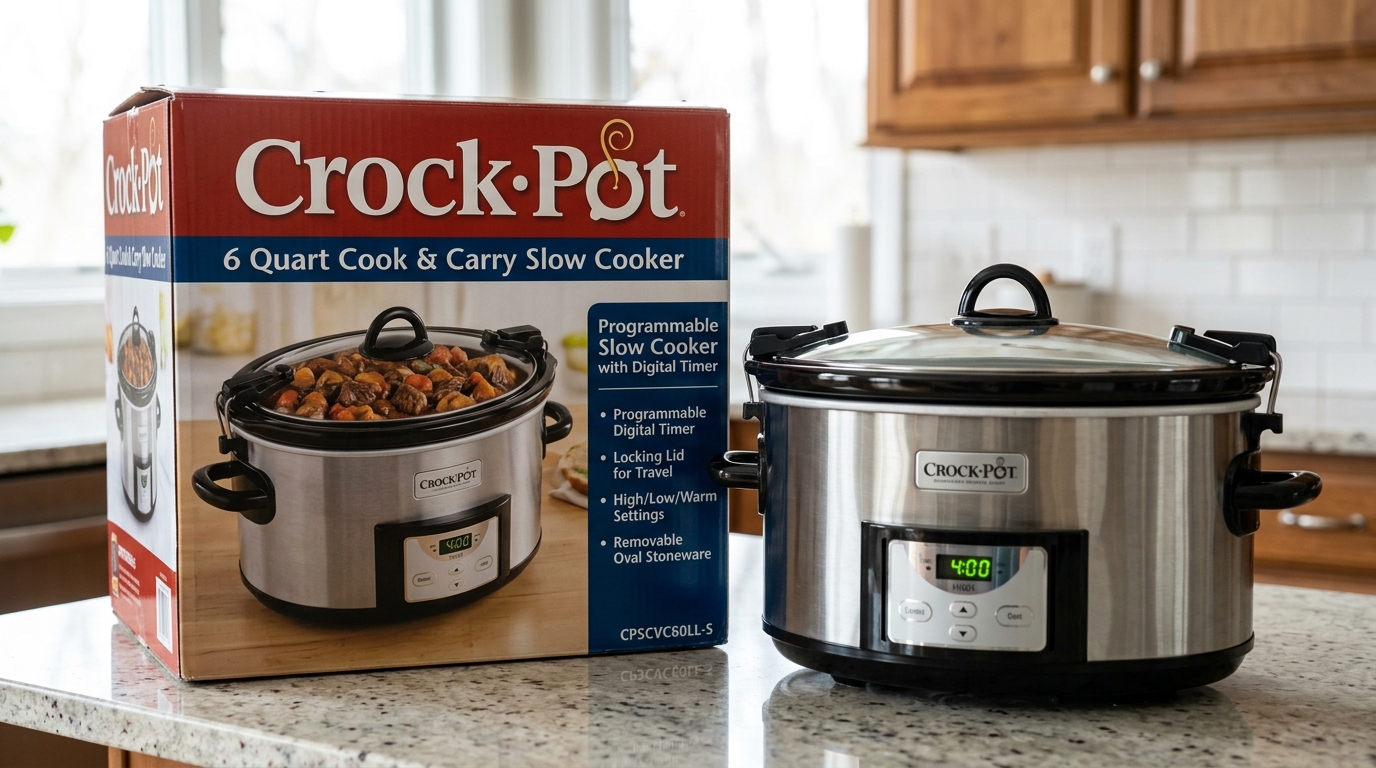
The Crock-Pot Cook & Carry is a 6-quart programmable slow cooker built with a stainless steel exterior and a digital timer system. It’s designed around two central ideas: giving users more precise control over cooking time through programmable settings, and making it easier to transport the appliance once cooking is finished, thanks to a locking lid and carrying handle system referenced in the “Cook & Carry” name.
At 6 quarts, the appliance is sized to accommodate small to medium households, generally suited to preparing meals for family dinners or bringing a dish to a gathering where portability matters as much as cooking performance. Its core purpose is to provide a dependable, programmable slow cooking appliance that removes some of the guesswork and risk associated with older manual-dial slow cookers, while also addressing the practical challenge of moving a full, hot dish from one location to another.
Key Features
Digital Programmable Timer
The defining feature of this model is its digital timer system, designed to let users set a specific cooking duration rather than relying on a simple low/high dial with no built-in cutoff. This is intended to reduce the risk of overcooking a dish if the cook isn’t available to manually switch off the appliance at the right time.
Automatic Warm Setting
Once the programmed cooking time is complete, the appliance is designed to automatically switch to a “keep warm” setting, intended to hold food at a safe serving temperature without continuing to actively cook it. This may be particularly useful for dishes prepared ahead of a specific mealtime, where the exact serving moment isn’t known precisely in advance.
Locking Lid for Transport
The “Cook & Carry” design centers on a locking lid mechanism, intended to keep the lid securely sealed during transport, reducing the risk of spills when moving a full slow cooker from the kitchen to a car, or from a car into a gathering space like a potluck or holiday event.
6-Quart Capacity
At 6 quarts, the appliance is designed to accommodate small to medium households, generally suited to preparing meals for roughly four to six people, depending on the specific dish and how it’s portioned.
Stainless Steel Exterior
The exterior housing is constructed from stainless steel, a material generally chosen for its durability and its ability to visually coordinate with other stainless steel kitchen appliances, offering a somewhat more polished look compared to an all-plastic housing.
Removable Stoneware Insert
Like most slow cookers, this model is designed with a removable stoneware insert, allowing the cooking vessel to be taken out for serving, cleaning, or storage separately from the heating base.
Materials and Design
The stainless steel exterior is designed to offer a more substantial, polished appearance compared to slow cookers with an entirely plastic housing, which may appeal to buyers who want their countertop appliances to visually coordinate with other stainless steel equipment already in their kitchen. The overall shape follows the fairly standard oval or round profile common to most slow cookers in this general capacity range, generally chosen to accommodate roasts, whole chickens, or larger cuts of meat that wouldn’t fit as easily in a narrower vessel.
The locking lid mechanism represents the most distinctive structural design element on this model. Rather than simply resting on top of the stoneware insert the way a standard slow cooker lid does, this lid is designed to clamp or latch securely into place, intended to remain sealed even when the appliance is tilted or jostled during transport. This kind of locking system typically works in conjunction with a carrying handle, designed to make it easier to grip and move the appliance safely once the lid is secured.
The stoneware insert itself is generally designed to be oven-safe up to certain temperature limits and dishwasher safe for cleanup, though checking the manufacturer’s specific guidance on both fronts is advisable, since not every slow cooker insert is rated for the same range of use beyond the appliance itself.
Performance
Performance in a slow cooker like this centers on its ability to maintain a low, consistent temperature over an extended period, allowing tougher cuts of meat, dried beans, or other ingredients that benefit from long cooking times to become tender without requiring active monitoring. The digital timer system is designed to apply that consistent low heat for a precisely programmed duration, then automatically shift to a lower “warm” setting once that time has elapsed.
Because slow cookers generally operate at fairly low, steady temperatures compared to stovetop or oven cooking, results tend to be more forgiving of small timing variations than faster cooking methods, though very significant overcooking can still affect texture, particularly for delicate ingredients like seafood or certain vegetables. The automatic warm setting is intended to reduce this risk somewhat by preventing the appliance from continuing to cook at full temperature indefinitely once the programmed time is complete.
As with any slow cooker, actual results will depend on factors like the specific cut or type of food being prepared, how much liquid is included in the recipe, and how full the stoneware insert is relative to its total capacity. Recipes specifically written for slow cookers tend to produce more predictable results than dishes adapted from stovetop or oven instructions without adjustment for the different cooking method.
Common Uses
This type of programmable, transport-friendly slow cooker is generally suited for:
- Weekday meal prep, using the programmable timer to start a dish in the morning and have it finish cooking, then automatically switch to warm, by dinnertime.
- Potlucks and family gatherings, using the locking lid and carrying handle to transport a finished dish without risking spills along the way.
- Tougher cuts of meat, such as pot roasts, pulled pork, or short ribs, which generally benefit from the low, extended cooking time a slow cooker provides.
- Soups, stews, and chilis, which are commonly prepared in slow cookers and tend to develop flavor well over several hours of low heat.
- Dried bean and legume dishes, which often require longer cooking times to soften properly compared to canned alternatives.
- Holiday side dishes, where the appliance’s capacity and portability may be useful for preparing a dish that also needs to travel to a different location for serving.
Advantages
- Reduced risk of overcooking: The programmable timer and automatic warm setting are designed to prevent a dish from continuing to cook at full temperature well past its intended finish time.
- Genuine transport convenience: The locking lid and carrying handle system may meaningfully reduce the risk of spills when moving a full, hot slow cooker between locations.
- Consistent capacity for most households: The 6-quart size is generally well suited to small to medium families without requiring an oversized appliance footprint.
- Stainless steel appearance: This exterior material may appeal to buyers who prefer a more polished look compared to all-plastic slow cookers.
- Hands-off cooking convenience: Like all slow cookers, this model is designed to allow extended, unattended cooking, which can be useful for busy schedules.
- Removable insert for easier serving and cleanup: Being able to take the stoneware insert out separately from the heating base simplifies both serving at the table and washing up afterward.
Things to Consider
A handful of practical points are worth reviewing before purchasing:
- Learning the digital timer interface: New users may need a bit of time to become familiar with programming specific cook times and understanding how the automatic warm setting behaves once that time elapses.
- Weight when full: A 6-quart stoneware insert filled with food can be fairly heavy, which is worth keeping in mind even with the carrying handle designed to assist with transport.
- Insert care requirements: Stoneware inserts generally require some care around sudden temperature changes, since extreme shifts — such as adding cold liquid to a very hot insert — can occasionally cause cracking.
- Counter and storage space: While generally more compact than larger kitchen appliances, a 6-quart slow cooker still requires a reasonable amount of storage space when not in use.
- Personal cooking style preferences: Some cooks may prefer the more hands-on control of stovetop or oven cooking for certain dishes, even with the convenience a slow cooker offers. Whether this appliance fits a given household’s typical cooking approach is ultimately a matter of personal preference and routine.
Comparison with Similar Product Categories
Compared to basic, non-programmable slow cookers with a simple low/high dial, this model’s digital timer and automatic warm function are generally designed to reduce the risk of overcooking, offering more precise control over the cooking process without requiring someone to be present to manually switch settings at the right time.
Compared to multicookers that include a slow cook function among several other cooking modes, a dedicated slow cooker like this one is generally more focused on that single cooking method, which may appeal to households that specifically want a straightforward slow cooking appliance rather than a broader multi-function device.
Compared to slow cookers without a locking lid or carrying handle, this model’s transport-focused design may offer a meaningful practical advantage for anyone who regularly brings dishes to gatherings, potlucks, or other locations outside their own kitchen, whereas standard slow cookers are generally better suited to at-home use only.
Compared to larger-capacity slow cookers, this 6-quart size strikes a reasonable middle ground, generally suited to small to medium households, while larger families or those who frequently cook for bigger groups might consider an 8-quart or larger model instead.
Maintenance and Care
Routine maintenance can help preserve the performance and longevity of a slow cooker like this one. General care recommendations typically include:
- Allowing the stoneware insert to cool before washing, to help avoid cracking that can sometimes result from sudden temperature changes between hot cookware and cold water.
- Hand washing or using the dishwasher as appropriate, checking the specific manufacturer guidance for the stoneware insert, since not all inserts are rated the same way for dishwasher use.
- Wiping down the heating base and exterior with a damp cloth, avoiding submerging the base unit in water since it houses electrical components.
- Checking the locking lid mechanism periodically to ensure it continues to latch securely, particularly if the appliance is used regularly for transport.
- Avoiding sudden temperature extremes with the insert, such as adding very cold ingredients directly to a hot stoneware insert, which can occasionally lead to cracking over time.
- Storing the appliance in a dry location, with the lid either off or resting loosely on the insert to help prevent trapped odors between uses.
Referring to the manufacturer’s included instructions remains the most reliable way to maintain both the performance and longevity of this appliance, particularly regarding specific guidance on the stoneware insert’s temperature tolerances and dishwasher compatibility.
Frequently Asked Questions
1. What household size is this slow cooker best suited for? The 6-quart capacity is generally well suited to small to medium households, roughly four to six people, depending on the specific dish being prepared.
2. How does the programmable timer work? It’s designed to let users set a specific cooking duration, after which the appliance automatically switches to a warm setting rather than continuing to cook at full temperature indefinitely.
3. What does the “Cook & Carry” name refer to? It refers to the appliance’s locking lid and carrying handle system, designed to make transporting a finished, hot dish safer and less likely to spill.
4. Is the stoneware insert dishwasher safe? This can vary, so checking the specific care instructions included with the appliance is recommended before placing the insert in a dishwasher.
5. Does the slow cooker turn off automatically when cooking time is complete? It’s designed to switch to a keep-warm setting rather than turning off completely, intended to hold food at a safe serving temperature until it’s ready to be served.
6. Can this slow cooker be used for potlucks or gatherings? Yes, the locking lid and carrying handle are specifically designed to make transporting the appliance to another location more secure and convenient.
7. Is the exterior made of stainless steel or plastic? The exterior housing is constructed from stainless steel, offering a more polished appearance compared to all-plastic slow cookers.
8. How long can food safely sit on the warm setting? This can vary depending on the specific dish and food safety guidelines; checking the manufacturer’s instructions and general food safety recommendations is advisable for extended warm settings.
9. Can I add cold ingredients directly to the hot stoneware insert? Sudden temperature changes are generally not recommended, since they can occasionally cause the stoneware insert to crack over time.
10. Does this slow cooker require constant monitoring while cooking? No, slow cookers are generally designed for hands-off cooking, and the programmable timer and automatic warm function are intended to reduce the need for active monitoring even further.
11. Is this appliance suitable for cooking dried beans? Yes, slow cookers are commonly used for dried beans and legumes, which generally benefit from the extended, low-heat cooking time this type of appliance provides.
12. How much storage space does this slow cooker require? It requires a reasonable amount of counter or cabinet space typical of a 6-quart appliance, though it’s generally more compact than larger multi-function cooking systems.
Final Thoughts
The Crock-Pot Cook & Carry Programmable Slow Cooker reflects a practical evolution of a long-standing kitchen appliance category, addressing two specific and common frustrations: the risk of overcooking without active supervision, and the challenge of transporting a finished dish safely. With its digital programmable timer, automatic warm setting, and locking lid designed for transport, it’s built to serve households that value both precise, hands-off cooking control and the ability to bring a finished meal somewhere else without worry.
As with any kitchen appliance, whether this particular model fits a given household ultimately depends on factors like typical meal preparation habits, how often dishes need to be transported elsewhere, and how much value is placed on programmable timing versus a simpler, more basic slow cooker design. Reviewing the manufacturer’s specifications and care instructions ahead of time can help set clear, realistic expectations before use.